Auckland PSITM  Institute and Psychotherapy

tPsychotherapy for the Whole Person t Training and Supervision for Healers t
 

[Home]    [Contact Me]    [Resume]     [Individual Psychotherapy]    [Therapy for Eating Issues]    [Couples therapy]    [List of Articles]       

[Online Training and Consultation]    [PSI Seminar]    [Eating Problems Seminar]    [Individual Supervision]    [Group Supervision]


"Click here for more Blossom Fuller"                          © by Judy Lightstone, 2000
Let’s start by defining compulsive eating as any eating out of relation to physiological hunger and satiation.  This means that anytime one eats for reasons other than hunger or bringing hunger to satiation, we say that eating was compulsive in nature.  Which is to say we all eat compulsively at times (i.e. for reasons other than physiological hunger).


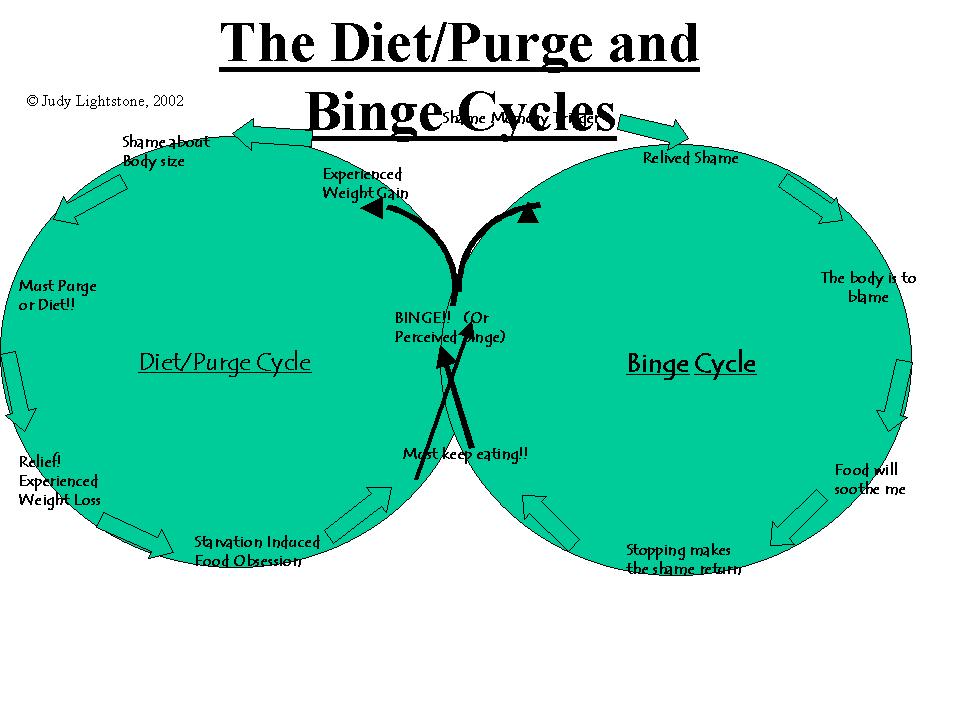
People with eating problems, however, eat compulsively consistently and feel terrible shame about both the behavior and the effects of the behavior (perceived or real) on their body size.  In fact, each compulsive eating episode tends to be accompanied by a great deal of shame, as shown in the cycles below.  Indeed it could be said that shame is the main ingredient that turns a "normal" experience of compulsive eating into a repetitive anguished pattern.

In my work with people with eating disorders, I listen to them carefully as they describe their eating in detail to me.  Below is a common pattern I have distilled from underneath the many stories I have heard.


© by Judy Lightstone, 2002

 As you see above, the binge (or perceived binge) is initially triggered by an event or thought that may also be associated to an earlier less conscious experience. The earlier experience may have included a great deal of shame.  That experience is then transferred to feelings of body shame, and self-critical thoughts.  At this point the person reaches for food to help salve the pain.

The shaming thoughts are then redirected onto the eating behavior, which puts the eating in a paradoxical role.  While it is soothing the person, it also acts as a scapegoat for the bad feelings that triggered the binge to begin with.  The eating behavior, and the soothing it brings, then becomes the enemy. The person then believes “I feel bad because I am eating” rather than “ I felt bad and so I ate”, because they no longer remember what made them reach for the food in the first place.

The person then has to keep eating because they still feel bad, and so they start to feel bad because they can’t stop eating.
The binge is experienced as out of control self-destructive behavior. The eating must continue or the original shameful feelings (now forgotten) will return. Eventually the experience of being over full will force the eating to stop. When the shame returns, the person may seek out the redemption of a diet, "purification" fast, or purge.  By this time the original trigger is completely obliterated by the drama of the binge and purge or diet. But whatever one tries to do to deny hunger, hunger will return.  If it is ignored, it will return with a vengeance, and this extreme state of hunger will trigger a perfectly normal and healthy reaction…a binge. But the person may have difficulty distinguishing between a binge triggered by waiting too long to eat, and a binge triggered by emotions that have nothing to do with physiological hunger – because the behavior is identical.  Confusing this healthy binge with a compulsive binge, the person will try to further resist his/her hunger, only to ultimately meet defeat (except for cases of anorexia). The diet, the purging, the fasting must end because the person must continue to survive, only now the view their survival instincts as harmful and shameful, and this begins the binge cycle again.

Example:

JL: What do you think made you go for the Oreos at 2PM yesterday?
Pt: Well, as you know, that's when I get home from my job, and then I have an hour to get to class.  I always binge then. I have trouble with transitions.
JL: Yes that seems to be a hard time of the day.  Can you remember what made it so hard yesterday?
Pt: I'm just stupid...it's stupid, that's all.  I used to see Joey during my break when we lived together…but that was so long ago and so that can't still be it.
JL: So you feel ashamed about still missing Joey? You should be over it by now?
Pt: I never get over anything. I'm so clingy and needy- no wonder he left me.
JL: So remembering that you used to see Joey then reminds you of the shame you feel for still needing him?
Pt: It makes me sick to think about it.
JL: Is that why you reached for the Oreos, do you think? Because of that sick feeling?
Pt:  Yes, but they just make me feel sicker! It doesn't make sense!
JL: Well it kind of makes sense if you wanted to forget the sick feeling about Joey, that you might cover it with a sick feeling about eating, which maybe doesn't feel as shameful.
Pt: But it does! I'm nothing but a big fat cow! All I do is stuff cookies to get fatter. Ugh!
**********************************************************
Here we see the shame originally associated with her clinging now reattaching to the relatively familiar and socially endorsed arena of her body.  From feeling isolated and humiliated by her neediness, she now joins the throngs of women who think they're too fat.  This feeling, as bad as it is, is clearly more tolerable.

Pt: I had a huge binge last night.
JL: Were you hungry?
Pt: I was starving, but I couldn’t stop eating. I was putting away food like I would never eat again – I just shoveled it in. It was disgusting.
JL: That is a normal way to eat when you are starving. How did you end up getting so hungry?
Pt: No. You didn’t see it – there was nothing normal.  I mean, I ate straight from the container – I didn’t even bother to heat it up.
JL: You must have been terribly hungry.  How did that happen?
Pt: Well, I had had such an awful binge the night before that I decided I could go the next day without any food.  I’ve done it many times before. But I was such a weakling.
JL: I don’t agree. There’s nothing “weak” or “bad” about feeding yourself when you are hungry.  We would do better to explore this idea that you have to starve yourself any time you have what looks to you like a compulsive eating episode.  Some of these “binges” may be perfectly normal reactions to abnormal deprivation.  In order to work through the actual compulsive eating episodes, we must first be able to distinguish them from binges that are in response to deprivation. The only way to be sure is to ask yourself if you are physically hungry first. If the answer is yes, then please, enjoy your food.

This approach goes against so many socially imposed beliefs that it is sometimes difficult to follow.  However, most realize that it makes sense, once they are more in tuned with their patterns of hunger and satiation.  There are even people in OA groups that are now defining abstinence in terms of only eating with hunger and satiation, which is a much more natural definition of abstaining from compulsive eating, in my opinion, than sticking to a low calorie food plan. According to the World Health Organization, an adult female requires 2,000-2,500 calories per day (depending on degree of activity).  Less than that is, by definition, substandard, and your body will fight hard to get and keep those calories.  Most restrictive food plans (as they are often called now that dieting has gotten a bad rep) attempt to keep your caloric intake below these basic requirements, and so, are bound to rebound eventually.  The dieter then blames him/herself and feels ashamed, fueling the die/binge cycles to continue.

For more on how I work with eating problems see: Therapy for eating problems

*******************************************************************************
Thoughts On Dieting
by Judy Lightstone © 1997

How Unhealthy Is Fat?

Dr. Andres, the clinical director of the National Institute on Aging, reports the results of extensive studies: the longest life expectancy exists for people who are 24% to 37% "overweight" by present standards (as defined by doctor’s charts). Most other studies have been based on actuarial statistics that are not normed against the general population.

Dr. George Mann of the National Heart and Lung Institute states that caloric restriction is not a useful treatment for chronic diseases, and fat per se has not been proved to cause hypertension, cancer or heart disease (most fat people with these diseases have other influences on their health that are not controlled for in typical studies: high stress, middle-age, and smoking). He sites a cross-cultural study that controlled for stress caused by the social stigma of being fat showed that very obese people in cultures where fatness is admired have lower incidence of high blood pressure and heart disease...).

Caloric Restriction = Thin = Health?

According to the World Health Organization, any diet below 2,000 calories per day is considered starvation level. For growing teens the number is closer to 2,500. Caloric restriction has been shown to cause many serious health problems -- both physical and emotional, including, of course, death. Because of various diet programs, diet and weight-loss pills, and surgical treatments (such as stomach stapling), people have suffered from malnutrition, electrolyte imbalances, cancer, heart failure, eating disorders, depression, and suicide. According to William Bennett and Joel Gurin, authors of The Dieter's Dilemma (1982) "the body reacts to stringent dieting as if famine had set in... the metabolic rate drops to conserve calories and maintain a stable amount of fat...[this also occurs with] fat people on diets, even though they still have an ample energy reserve... because of this innate biological response, dieting becomes progressively less effective ..." Though large amounts of weight loss due to calorie restricting diets are common, 90% of people regain all or more of the weight they originally lost. In most cases, caloric restriction below starvation level (2,000 calories) cannot be maintained for a lifetime, and so we see the yo-yo effect with chronic dieters gaining and losing weight again and again, getting larger and larger over time.

Who Gains from Our Thin Obsession?

$33 billion per year are spent on the diet industry today (in 1980 that number was $10 billion). Diet foods, surgery, programs, books, resorts, doctors, drugs... the diet industry is getting very fat off the unsuccessful attempts of millions of people to get thin.

What’s Happening to Us and Our Children?

A recent national health study, that studied 2,379 nine and ten year-old girls (approximately half White and half Black) found that 40 % of them reported that they were trying to lose weight (Striegel-Moore et al, 1996). A study of 36,000 students in Minnesota found that negative body image is associated with suicide risk for girls, not for boys. Another study found that "the way I look" was the most important determinant of self-worth for White middle school girls. Parental messages about body image and teasing by others (e.g. peers and/or family) have been highly correlated with body image dissatisfaction and eating disorder symptoms. (Thelen & Cormier, 1995).

Our thin obsession currently means that the 33% of American women who wear a size 16 or larger are stigmatized and pushed onto diets, that 50% of all American women are on a diet at any one time, and that 80% of women have dieted at some time. Most ominous is how this is being passed on to our children. 50% of all nine year old girls have dieted, according to Naomi Wolf, author of The Beauty Myth, 1992, and 1% - 4% of high school and college girls have Anorexia and/or Bulimia according to author Mary Pipher of Reviving Ophelia 1994.

So, What Size Should I Be?

One of the medical criteria of anorexia nervosa: body weight 15 % below a weight that is considered "normal" , is met by the majority of models and beauty contestants.

Since there are no clear markers for healthy body weight that are free from highly questionable social standards, I would maintain that healthy body weight is the size a person naturally returns to after a long period of both non--compulsive eating and consistent exercise commensurate with the person' s physical health and condition. We must learn to advocate for ourselves and our children to aspire to a naturally determined size, even though that will often mean confronting misinformed family, friends, and media advertising again and again.

What is Non-Compulsive Eating?

Simply stated, non-compulsive eating means eating when you are hungry and stopping when you are satisfied. This involves being able to distinguish emotional hunger from physical hunger, and satiation from overfullness.


...


254 Lincoln Road, Henderson, Waitakere City, West Auckland, New Zealand.       E-mail: jlightstone@gmail.com        Phone +64 (09) 835-1929 

Fax +64 (09) 833-1821


[Home]    [Contact Me]    [Resume]     [Individual Psychotherapy]    [Therapy for Eating Issues]    [Couples therapy]    [List of Articles]       

[Online Training and Consultation]    [PSI Seminar]    [Eating Problems Seminar]    [Individual Supervision]    [Group Supervision]